Interview
Kiiōtō, between time and sound
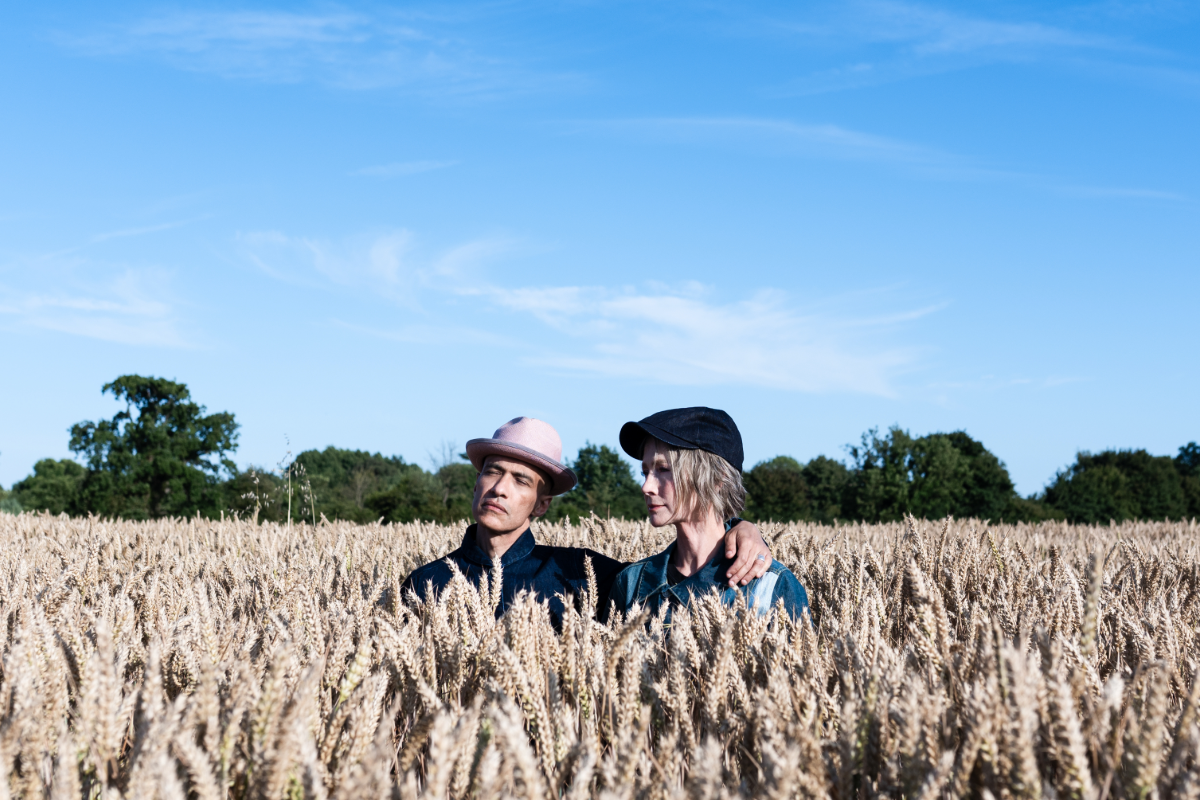
In their home in London, the story of Kiiōtō unfolds. Singer Lou Rhodes and keyboardist Rohan Heath only found each other after decades. Their debut album As Dust We Rise, released in 2024, impressed with music that is simultaneously lightly moving and deeply rooted. On the follow-up, Black Salt, the duo continues to search for freedom, form, and depth. Ludo Diels and Louis Nouws visited the pair for a special encounter.
Tekst Ludo Diels en Louis Nouws
It takes about twenty minutes to get to the Hampstead district from central London by Uber. You drive past names steeped in history: Park Lane, St John’s Wood, Abbey Road Studios… The city gradually becomes lighter, more spacious, and softer in tone. We first explore the neighborhood. Understated elegance. Victorian and Georgian facades, shops with character, delicatessens, and specialty stores.
We have a pint at the King William IV.
“You were in King Willie,” says Rohan Heath with a big smile when we tell him about our exploration. A pub with a clear reputation. Hampstead has its own atmosphere. Village-like in a city way. Artists, musicians, and writers love to settle here.
George Orwell and Edward Elgar once lived here; nowadays, you might bump into Ricky Gervais or Boy George. We begin with a walk across the famous Hampstead Heath, a beautiful expanse of parkland that rises above the surrounding area, offering magnificent views across much of London.
The park is a popular setting for films and series and has inspired novels. It was also here that the name Kiiōtō originated, during a walk, as the couple would explain later that evening. The name is derived from the old Japanese imperial city famous for its many temples and beautiful gardens, but it was primarily the sound that stuck. The double i and the accents on the o betray a preference for the unique, the slightly deviant. Nothing is what it seems with Kiiōtō.
Sometimes, after an interview, someone says, “Come by sometime and we’ll have a meal together.” More often than not, it is simply a polite remark. Occasionally, however, such an invitation carries real meaning. Last year, at Festival 043 in Maastricht’s Muziekgieterij, my conversation with Lou Rhodes and Rohan Heath after the Heaven Session felt like one that should not end there. It seemed the beginning of a longer exchange. Emails followed, and before long came an invitation to visit them in London.
The front door opens. Lou and Rohan – it somehow feels right to use their first names – give us a warm welcome. Their home immediately feels both inviting and lived-in, full of warmth and care. We head downstairs to the basement, where the kitchen is and the table has already been laid. The cava sparkles in our glasses and the cod is in the oven, nearly ready. Miles Davis drifts softly through the room. They are clearly people of taste, something reflected in the artwork on the walls. Nothing demands attention, yet for all its apparent ease, the interior reveals an aesthetic sensibility and a keen eye for detail.
“Inviting journalists to your home for dinner is strongly discouraged if you are signed to a label,” laughs Rohan. “You only do that if you are in charge yourself.” Rohan and Lou no longer let anyone dictate anything to them. They got to know the pop industry from the inside out when they celebrated success with their previous bands – Lou with Lamb, Rohan with Urban Cookie Collective. They played at Glastonbury several times, and if they wanted to, they could easily make a good living in the retro circuit. But they don't want that. Not that they turn down a good living, but they want to make music on their own terms. To go wherever their creativity takes them. Or as Lou says: “The moment we make the music that others expect from us from afar, it is no longer interesting to us.”
Their debut album, As Dust We Rise, was released – fittingly, on their own label – in 2024. It was the culmination of a remarkable artistic and personal partnership. The two had known of each other through Manchester’s music scene in the 1990s, but only in passing. As Rohan puts it: “Lou didn’t notice me.”
She formed the duo Lamb with Andy Barlow, where she sang and wrote the lyrics, and Barlow largely determined the electronic-infused sound. The band enjoyed a very successful period from 1994 to 2004 and added a sequel to that from 2009 to 2019. The album The Secret Of Letting Go was their swan song. While she wanted the music to be guided primarily by intuition, Barlow was more drawn to a structured and clearly defined approach.
By this time, Lou had achieved success as a solo artist. Her debut album Beloved One (2006) was nominated for the Mercury Prize, which is certainly highly regarded in England. Three more albums followed, but she gradually became less enthusiastic about life as a musician. And when Covid brought public life more or less to a standstill, she decided to leave music behind and focus on literature and poetry. She already had two children's books to her name: The Phlunk and The Phlunk’s Worldwide Symphony.
The two were introduced to each other by mutual acquaintances from Manchester. Contact was initially via email. Lou: “Even before I had seen Ro, I fell in love with his choice of words, his way of communicating.” The project they were supposed to work on together came to nothing, but after the two met in person, they became inseparable. Or as Rohan says with a laugh: “She invited me to dinner at her home and I haven't left since.” She still has her house in the countryside near Bath, but she now spends a large part of her time in Hampstead.
Five years ago, Rohan had also reached the point of saying goodbye to the music business. He had toured with Jamaican singer Eek-A-Mouse and performed with the rave band Together. With Urban Cookie Collective, he had had hits with The Key, The Secret, and Feels Like Heaven, during which he would step away from his keyboards to jump around the stage and entertain the audience. When he met Lou, he was working on a novel. His father is the British-Guyanese writer Roy Heath, whose work has also been translated into Dutch. To prove this, he pulls a copy of De Moordenaar from the bookshelf. “He was immediately successful with that debut. He wrote it in six weeks, during the school holidays. He was a teacher. His other books took him years.” Rohan tells this to illustrate that it is often better to start a project without inflated expectations. It is the parable of Kiiōtō.
There was a piano in the kitchen of Lou’s house. She cooked and sang, and he laid down his chords. Lou: “Ro’s chords evoked something in me that made songs emerge naturally, as it were. His piano playing has a jazzy feel without really being able to call it jazz. I remember that summer when the weather was beautiful and I listened a lot to Bill Evans’ music. I wanted to learn to play the piano better too. Song For Bill is one of the songs on our debut album As Dust We Rise.”
The standout track from that album originated during a trip to New Orleans. They wrote Josephine Street during a stay in a neighborhood that, despite its outward decay, still radiated warmth and togetherness. They made the journey to the Deep South of the US after a DNA test had shown that Rohan’s family had significant roots there. “The country has always attracted me, and certainly the music as well. I have a broad taste anyway. I think the records from the ECM label are beautiful, but I also love Funkadelic. And you might not expect it, but I am a big Neil Young fan. Both of the singer-songwriter and the rocker. Maybe it isn't an advantage for a musician to like so many different kinds of music; people like to put you in a box, but I just make the use of it.” “If you had to characterize us,” says Lou, “Ro stands for movement and I for stillness. He is always bursting with ideas. Give him ten minutes and he delivers ten ideas for songs in no time.” Rohan: “That is also immediately the easiest part of the process, the free-flowing stage. After that comes the hard work, developing an idea into a song that makes sense.”
Kiiōtō's music moves between jazz and folk. Music that does not like to be categorized. The instrumentation remains clear and open. Lou's voice forms the centerpiece, the secret weapon: slightly trembling, precise, constantly in motion, sometimes described as elegiac. On Black Salt, the bass also carries a significant part of the story, melodically and rhythmically at the same time. Accessible, rich, and thoughtful. Music that appeals to body, mind, and soul. On Black Salt, they explicitly seek space within the form. Songs are given longer introductions, themes are stretched out and approached anew. Like in the opening track Moth, which is about attraction, starting small but ending grandly with a gospel choir. They view Lost Map as one of the key songs on the album. It originated from Rohan's DNA test, which brought new lines to light. The song unfolds like a map slowly becoming visible, with a muted trumpet taking center stage: Was it something I said/Brought the avalanche to fall?/The lost map in our heads/Suddenly was all we saw.
Harmonic shifts tell their own story, parallel to the melody. It yields music that unfolds, with a tension arc that keeps breathing. Rohan speaks of harmonic development, of form and arrangement. Composition as a way to deepen emotion. With contrasts, with space, with attention to detail. Lou sees two movements in music. The flow, in which everything arises spontaneously. And the technique, which makes it possible to carry and share that inspiration.
Their work emerges within that field of tension. Ideas present themselves, sometimes in fragments, sometimes as almost finished forms. Rohan develops them, shifts, refines, and rearranges, while Lou searches for the right timbre, for a way of singing that opens the song rather than closes it off. Thus, a composition grows organically, layer by layer, until the moment when everything seems to fall into place. As if it had always been there.
Sometimes it begins with a single chord progression on the piano. Sometimes with a phrase, an image, a memory. From there, it grows, without a fixed plan, but with a keen sense of direction. They complement each other. Intuition and structure move side by side and reinforce each other. In their collaboration, a balance emerges that is audible. Freedom forms the starting point. Self-management, own choices, own pace. Their past provided insight, their current work provides direction.
The debut As Dust We Rise came about quite easily. Lou: “We were discovering each other and delighted with our collaboration. It also explained the title of the record. Our dusty musical ambitions swirled back up through our collaboration. It felt like a honeymoon. For the songs on Black Salt, we met in places where things sometimes rubbed more.”
As an example, they mention Five Eight, which closes the album. Rohan: “August 5th is the anniversary of my mother's death. In the first version I had, the song was called Mother. When Lou started getting involved with the lyrics, I did have some trouble with that. She was venturing into territory where I would rather be alone. But I opened myself up to her input.”
“In writing it I had to imagine the death of my own mother,” says Lou. “That gave the song a more universal character. Consequently, the original title no longer fit.”
Black Salt is not based on a blueprint. Lou: “Our starting point is that we make the music we like to hear ourselves.” They have freed themselves from the laws of the music business, which primarily thinks in terms of formats and target audiences.
Rohan: “We have nothing left to prove. That gives us space. But we don't do it as a hobby. We put our heart and soul into it.” The fact that their names still resonate in the scene makes the small-scale restart a bit easier, Lou acknowledges. “I feel sorry for bands that are at the beginning of their careers. How do you stand out among that enormous supply of songs on streaming platforms? We have reached a position where we feel that life is too short to let much stand in the way of our creativity.” And besides, we are brave enough to say no to quick and easy solutions. Because those exist too. We would earn more money with less hassle if we got involved with the nostalgia circuit.”
They don't feel too big to perform in smaller venues, often just the two of them, sometimes with a bassist or a violinist by their side. Choosing a small scale also has its limitations.
Rohan: “It is of course nice to bring the music to the stage with a band, but as a duo we can also make every performance a unique experience. Naturally, we work with samples then, but there remains plenty of room for improvisation.”
Lou: “Stepping onto the stage can be daunting. But for me, it often feels like I am standing in the eye of a hurricane. Everything surrounding a performance is hectic in one way or another.” Delays in the travel schedule, checking at the hotel, soundchecking, and then a quick bite to eat. But once on stage, all that falls away, then I get completely into the moment.”
In late 2024, they started working on Black Salt in between gigs and other commitments. The setting was producer Simon Byrt's London studio. Lou had worked with him before. “He is best known for his connection with the Icelandic Emilíana Torrini, for whom he also writes music. His studio is somewhat like a museum of analog equipment. He goes all out for that sound.”
Rohan: “With Simon on board, we had to look for a new balance again. He is quite, how shall I put it, very present, and so am I.” Lou: “Between those two powerhouses, I was the one who had to keep a cool head.” Rohan: “She managed that remarkably well. Simon is the kind of person who takes photos of the mixing console settings.” He makes a gesture of: what era are we living in? Some guitar parts on the album were played by David Arnold, to whom a lovely anecdote is attached, which Rohan tells in the surprisingly deep city garden behind his house, where we briefly walk to see the residence of architect Ernö Goldfinger from there. That master builder, who died in 1987, was known for his modernist style. The listed house contrasts quite sharply with the romantic architectural styles of the rest of the neighborhood. “Ian Fleming hated that way of building so much that he named the villain in his Bond story Goldfinger.
But back to David. It turned out he was one of my neighbors. I didn't know him until we struck up a conversation one time in the local supermarket. It turns out that, among much more, he composed the film scores for five Bond films. A celebrity, then. That is also the beauty of Kiiōtō. We can simply decide to let a neighbor play along.” He laughs heartily. “Wonderful, isn’t it? He isn’t going to tour with us, by the way.”
We continue the evening on the ground floor, where Rohan's keyboards are located next to the seating area. The pace slows down and the conversation takes its course. It is about music, life, art, and memories. They are going to be busy in the near future. “We are really looking forward to that,” says Lou. “We can’t wait to play the songs and see what it does to the audience.”
As the evening slips into night, we say goodbye. The Uber zips us back to the heart of London. In the distance, Hampstead lingers for a moment as a sweet memory.